
June 16 has been marked by landmark legal decisions, political milestones and moments that shaped American and world history.
On this date
In 1858, Abraham Lincoln accepted the Illinois Republican Party’s nomination for U.S. Senate and delivered his famous “House Divided” speech, warning that the nation could not survive permanently half slave and half free.
In 1897, the United States formally annexed Hawaii by treaty, paving the way for the islands to eventually become the 50th state in 1959.
In 1903, Henry Ford incorporated the Ford Motor Company with $28,000 in cash from a dozen investors. The company would go on to revolutionize American manufacturing and transportation.
In 1904, James Joyce’s story “Ulysses” is set on this date, which is now celebrated worldwide as “Bloomsday” in honor of the novel’s protagonist Leopold Bloom.
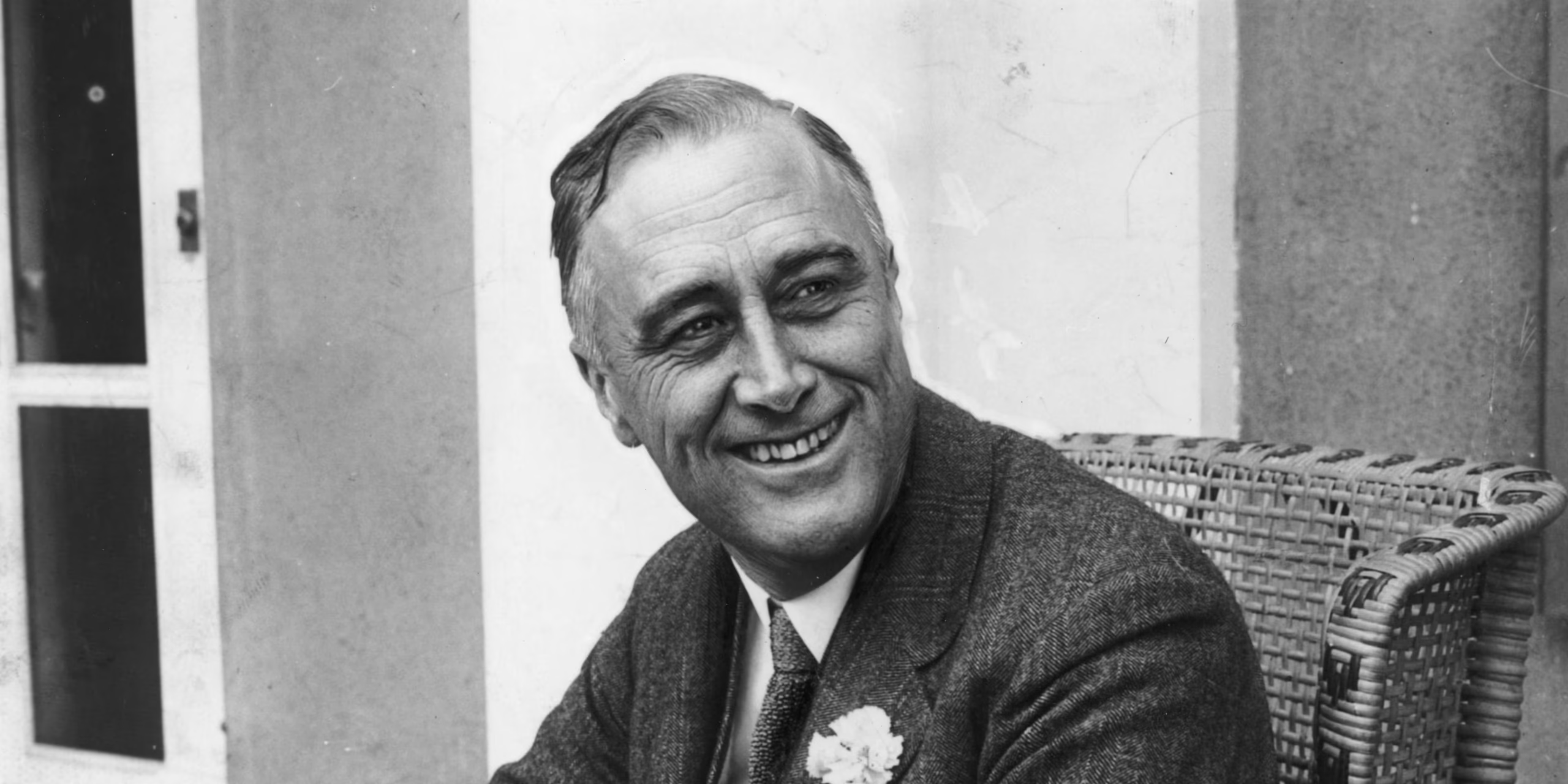
In 1933, President Franklin D. Roosevelt signed the National Industrial Recovery Act and the Glass-Steagall Banking Act into law as part of his New Deal response to the Great Depression. The Glass-Steagall Act separated commercial and investment banking for decades.
In 1944, George Junius Stinney Jr., a 14-year-old Black boy in South Carolina, was executed for the murders of two white girls in a case widely regarded as a grave miscarriage of justice. He was exonerated 70 years later, in 2014.
In 1955, Argentine President Juan Perón survived a coup attempt when navy aircraft bombed Plaza de Mayo in Buenos Aires, killing more than 300 civilians.
In 1963, Soviet cosmonaut Valentina Tereshkova became the first woman in space, orbiting Earth 48 times over nearly three days aboard Vostok 6.
In 1976, student protests in Soweto, South Africa, against apartheid-mandated education erupted into violence when police opened fire on demonstrators. The Soweto Uprising became a turning point in the fight against apartheid.
In 2015, a gunman opened fire at Emanuel African Methodist Episcopal Church in Charleston, South Carolina, killing nine people during a Bible study session in one of the deadliest attacks on a Black church in U.S. history.
Notable births
1801 — Julius Plücker, German mathematician and physicist who made early contributions to cathode ray research.
1890 — Stan Laurel, British-born comedian and the bumbling half of the Laurel and Hardy comedy duo.
1902 — Barbara McClintock, American scientist who won the 1983 Nobel Prize in Physiology or Medicine for her discovery of genetic transposition — the first woman to win that prize unshared.
1917 — Katharine Graham, publisher of The Washington Post who oversaw coverage of both the Pentagon Papers and the Watergate scandal.
1937 — Erich Segal, American author best known for writing “Love Story.”
1952 — Gino Vannelli, Canadian singer-songwriter known for his 1970s and 1980s pop hits.
Notable deaths
1858 — James Buchanan Henry, nephew of President James Buchanan.
1977 — Wernher von Braun, German-American rocket scientist and aerospace engineer who played a pivotal role in developing the Saturn V rocket that carried American astronauts to the moon, died at age 65.
1997 — Jacques-Yves Cousteau, French naval officer, explorer and filmmaker who brought the ocean to living rooms around the world through his television documentaries, died at age 87.
Discover more from Heavener.news
Subscribe to get the latest posts sent to your email.